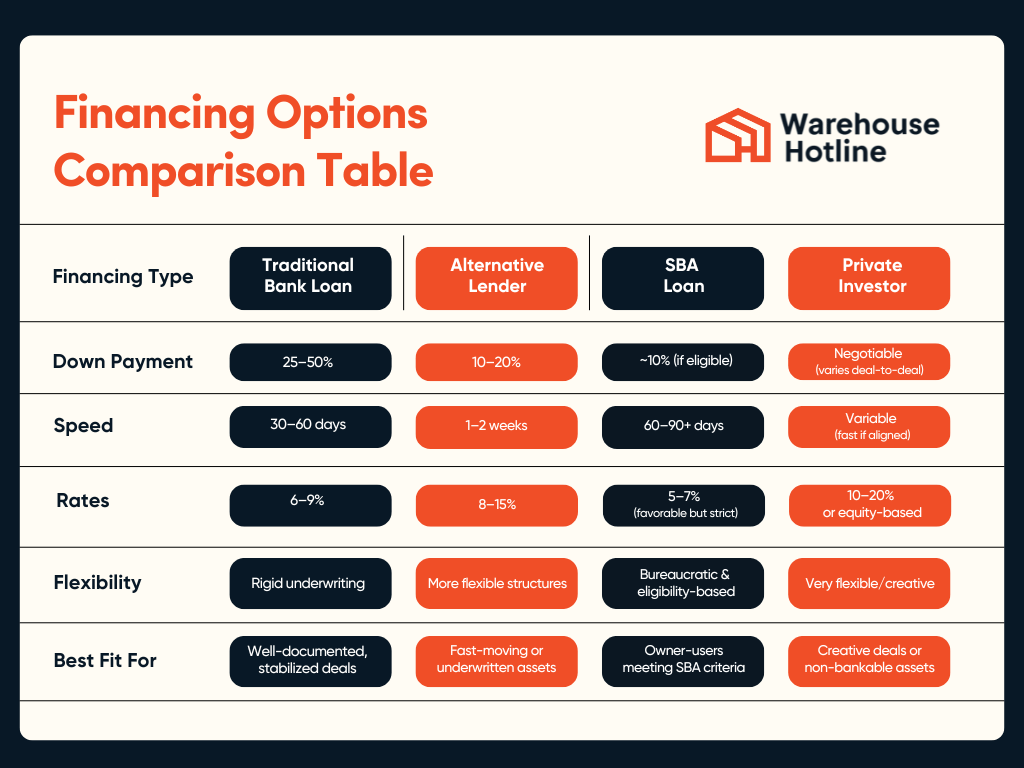
The shift toward e-commerce and supply chain reshoring has fundamentally changed the industrial real estate landscape. Warehouses are no longer just functional boxes on the outskirts of town; they are now mission-critical assets for the modern economy. For commercial property investors, this translates into strong rental demand and impressive appreciation potential. However, capitalizing on this trend requires significant capital, and securing the right funding is often the biggest hurdle between you and a lucrative deal.
Navigating the world of commercial lending can feel overwhelming, especially when you are dealing with specialized asset classes like industrial facilities. Unlike residential mortgages, warehouse financing hinges on the income the property generates and the specific risk profile of the tenant. Whether you are looking to acquire a last-mile distribution center or a large-scale logistics hub, understanding the nuances of your funding options is essential to maximizing your return on investment (ROI) and avoiding costly mistakes.
This guide breaks down the best warehouse financing options for commercial property investors available in the current market. We will dissect the pros and cons of traditional banks, government-backed programs, and alternative lenders so you can choose the strategy that aligns with your portfolio goals and financial standing.
Understanding the Unique Dynamics of Industrial Property Loans
Before diving into specific loan products, it is crucial to understand how lenders view industrial properties. Unlike multifamily or office spaces, warehouse valuations are heavily tied to functionality. Ceiling height, column spacing, dock doors, and truck apron space are not just architectural details; they are valuation drivers. A building with a 32-foot clear height is significantly more valuable than one with 18-foot ceilings because it offers more storage capacity per square foot.
Lenders also focus heavily on the creditworthiness of the tenant. A long-term lease with a national logistics company like FedEx or Amazon is seen as a “credit lease” and can secure you much more favorable terms than a lease with a small, regional distributor. When you approach a lender, be prepared to present a comprehensive rent roll and operating statement. The debt service coverage ratio (DSCR)—typically required to be at least 1.25x—is the primary metric they will use to assess your cash flow stability.
Conventional Bank Loans: The Traditional Backbone
For investors with a strong balance sheet and a long track record, conventional commercial mortgages from banks or credit unions are often the first port of call. These are typically structured as 5, 7, or 10-year balloon loans with amortization periods extending up to 25 or 30 years. They offer the most competitive interest rates in the market, often tied to the SOFR (Secured Overnight Financing Rate) or the 10-year Treasury yield.
The primary advantage here is the low cost of capital. However, the underwriting process is rigorous. Banks usually cap loan-to-value (LTV) ratios at 65% to 75% for industrial properties. They also require substantial liquidity reserves—often a full year of debt payments in cash—and a personal guaranty from the principal. If you are acquiring a value-add property that needs significant capital improvements, a bank might be hesitant, as they prefer stabilized assets with predictable income.
Portfolio Loans vs. Agency Loans
Within the conventional sphere, you can choose between a portfolio loan (kept on the bank’s books) or a loan sold to agencies like Fannie Mae or Freddie Mac. For pure industrial properties, Fannie Mae has a specific “Small Balance Loan” program, but it is less common than for multifamily. Usually, investors opt for portfolio loans for warehouses because they offer more flexibility in terms of prepayment penalties and underwriting exceptions, provided you have an existing relationship with the bank.
Government-Backed Programs: SBA 504 and SBA 7(a)
The U.S. Small Business Administration (SBA) offers two excellent avenues for owner-occupiers or investors willing to use the property for their own business. While these are not typically used for pure “rental” plays, they are among the best warehouse financing options if you plan to operate your distribution business out of the building.
The SBA 504 Loan is specifically designed for fixed assets like real estate. It involves a partnership between a bank (lending 50%), a Certified Development Company (CDC) (lending 40%), and your down payment (10%). This structure allows for a stunning 90% LTV, which is almost unheard of in commercial real estate. The CDC portion is fixed-rate and has a long maturity (20 or 25 years), providing excellent cash flow stability. The trade-off is that you must occupy at least 51% of the property, and there are limits on the business’s net worth and net income.
Alternatively, the SBA 7(a) Loan is more flexible for working capital but can also be used for real estate up to $5 million. It offers lower down payments than conventional loans. However, interest rates are typically higher than a 504, and the SBA charges a guaranty fee that can add to your closing costs. If you are a business owner looking to control your logistics costs, these programs are a strategic fit.
Bridge Loans and Short-Term Financing Strategies
In a competitive market, speed wins. If you are bidding on a warehouse that is currently underperforming or has a vacancy you plan to fill quickly, a bridge loan is often the only viable option. These are short-term loans (12 to 36 months) provided by private lenders, debt funds, or hard money lenders. They are interest-only or partially amortizing, allowing you to preserve capital for renovations or tenant improvements.
Bridge financing is expensive—rates can range from 7% to 12%—but they solve a specific problem: they allow you to acquire the asset now and refinance into permanent financing later once the value has increased. This is known as the “buy, fix, lease, refinance” strategy. The key to success here is having a clear exit strategy. Lenders will want to see a realistic timeline for stabilization and a proforma that justifies the new appraised value.
When to Use a Hard Money Lender
Hard money lenders are a subset of bridge lenders who focus almost exclusively on the asset’s “as-is” value rather than your credit score. They can close in as little as 7-10 days, which is crucial for distressed sales or auction purchases. However, they often require higher down payments (30% to 40%) and charge significant origination points. Use this option sparingly and only when you have a high degree of confidence in your exit plan.
Small Business and Alternative Online Lenders
If you are looking for a smaller loan amount—say, between $500,000 and $3 million—you might find that big banks are not interested. They often have minimum loan thresholds that make small deals unprofitable for them. This is where alternative online lenders and small business lending platforms step in. They offer a streamlined application process and faster decisions, often using automated valuation models (AVMs) to assess the warehouse.
These lenders are more flexible with credit scores but compensate by charging higher interest rates and requiring shorter amortization periods. They are an excellent stop-gap for investors who cannot wait 45 days for a bank to underwrite a deal. However, always read the fine print on prepayment penalties, as some of these platforms lock you in for several years.
If you are also exploring residential side of your portfolio, you might want to review the best mortgage lenders for investment properties in the United States to see if your relationship with a residential lender can be leveraged for a commercial referral.
CMBS and Institutional Financing for Large Portfolios
For seasoned investors acquiring portfolios of warehouses or single assets exceeding $10 million, Commercial Mortgage-Backed Securities (CMBS) loans are a powerful tool. These loans are pooled together and sold as bonds on the secondary market. The main advantage of CMBS is the ability to secure “non-recourse” financing, meaning the lender cannot come after your personal assets if the loan defaults, provided you did not commit fraud.
CMBS loans offer high leverage (up to 80%) and competitive fixed rates for terms of 5 to 10 years. The downside is the lack of flexibility. They are “single-asset” loans with strict lockbox provisions and cash management requirements. If you need to sell a property early or pay down principal, the prepayment penalty is calculated using a “yield maintenance” formula, which can be incredibly expensive. This is a product for investors with a clear hold period and predictable cash flows.
How to Structure Your Application for Approval
Regardless of the lender you choose, your application package needs to tell a compelling story. You must demonstrate that the warehouse is a safe bet. Start with a professional appraisal that highlights the functional utility of the building. Next, provide a detailed rent roll and executed leases. Lenders want to see a weighted average lease term (WALT) of at least 5 years.
You should also bring your personal financial statement and tax returns. If you are using an LLC to hold the property, expect the lender to look through the entity to your personal credit history. A credit score above 700 is generally required for the best rates. Finally, have a clear business plan. If you are buying a vacant warehouse, explain how you plan to market it and what type of tenant you are targeting. For more insights on managing your business finances effectively, you can review how CRM vs ERP: what’s the difference and which one do you need could help you track your rental income and maintenance costs post-acquisition.
Conclusion
Securing the right financing for a warehouse investment requires a strategic approach that balances cost, speed, and risk. There is no one-size-fits-all solution; the best warehouse financing options for commercial property investors depend entirely on your business model. If you are an owner-occupier, the SBA 504 offers unbeatable leverage. If you are a flipper, a bridge loan is your engine. If you are building long-term wealth, a conventional bank loan with a fixed rate provides the stability you need.
Take the time to interview multiple lenders and compare term sheets, focusing on the interest rate, amortization schedule, and prepayment penalties. The industrial sector is booming, but the margins are won in the financing. A well-structured loan can turn a decent property into a phenomenal investment, while a poorly structured one can erode your returns for years. Do your due diligence, build your network of lenders, and be ready to move when the right deal appears.
Frequently Asked Questions (FAQ)
What is the typical down payment required for a warehouse investment loan?
For conventional commercial loans, expect to put down 25% to 35% of the purchase price. However, if you qualify for an SBA 504 loan and plan to occupy the building, you can reduce your down payment to as little as 10%.
Can I use a residential mortgage to buy a commercial warehouse?
No. Residential mortgages are strictly for properties with 1-4 units that are primarily used for dwelling. To purchase a warehouse, you must use a commercial real estate loan, which has different underwriting criteria focused on the property's income potential.
How does the lender assess the value of the warehouse?
Lenders rely on a commercial appraisal that uses three approaches: the income approach (capitalizing net operating income), the sales comparison approach, and the cost approach. For industrial properties, the income approach is the most heavily weighted.
What is a DSCR and why does it matter for warehouse financing?
DSCR stands for Debt Service Coverage Ratio. It is calculated by dividing the property's net operating income by the total annual debt payments. Most lenders require a DSCR of at least 1.25, meaning your income covers your loan payments 1.25 times over.
What are the least expensive financing options for a large logistics center?
For stabilized assets over $5 million, CMBS loans or institutional life insurance company loans typically offer the lowest interest rates. They offer non-recourse terms, but require substantial closing costs and strict financial reporting.
Is it easier to get a loan for a warehouse with a long-term tenant already in place?
Yes, significantly easier. A signed lease with a creditworthy tenant reduces the lender's risk of vacancy. This "credit lease" can even lower your interest rate and increase the maximum loan-to-value ratio available to you.